Systems of Linear Equations
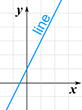
A System of Equations is when we have two or more equations working together.
An example will help:
Example: You versus Horse
 |
It's a race!
You can run 0.2 km every minute.
The Horse can run 0.5 km every minute. But it takes 6 minutes to saddle the horse.
How far can you get before the horse catches you?
|
We can make two equations (d=distance in km, t=time in minutes):
| You: | d = 0.2t | |
| The Horse: | d = 0.5(t-6) |
So we have a system of equations, and they are linear:
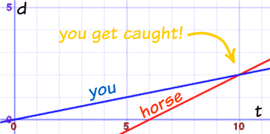
It seems you get caught after 10 minutes ... you only got 2 km away.
Run faster next time.
So now you know what a System of Linear Equations is.
Let us continue to find out more about them ....
Solving
Now, a linear equation is not always in the form like y = 3x+2,
It can also be something like y - 3x = 2
Or -3x + y = 2
These are all the same linear equation
And there can be many ways to solve linear equations!
Let us see another example:
Example: Solve these two equations:
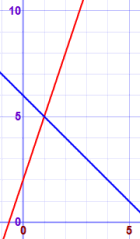
- x + y = 6
- -3x + y = 2
The two equations are shown on this graph:
Our task is to find where the two lines cross.
OK, we can see where they cross, but let's solve it using Algebra!
Hmmm ... how should we solve this? There can be many ways! In this case both equations have "y" so let's try subtracting the second equation from the first:
x + y - (-3x + y) = 6 - 2
Which simplifies to:
x + y + 3x - y = 6 - 2
4x = 4
x = 1
So now we know that x=1 is on both lines.
And we can find the matching value of y using either of the two original equations (because we know they have the same value at x=1). Let's use the first one (you can try the second one yourself):
x + y = 6
1 + y = 6
y = 5
And the solution is:
x = 1 and y = 5
And the graph shows us we are right!
Linear Equations
| A Linear Equation can be in 2 dimensions ... (such as x and y) | 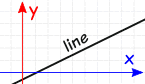 | |
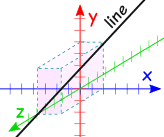 | ... or 3 dimensions (such as x, y and z) ... | |
| ... or 4 dimensions ... or more! | (I just can't draw those) |
And only simple variables. No x2, y3, √x, etc:
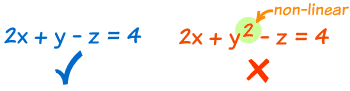
Linear vs non-linear
Common Variables
For the equations to "work together" they share one or more variables:
A System of Equations has two or more equations in one or more variables
Many Variables
So a System of Equations could have many equations and many variables.
Example: 3 equations in 3 variables
| 2x | + | y | - | 2z | = | 3 |
| x | - | y | - | z | = | 0 |
| x | + | y | + | 3z | = | 12 |
There can be any combination:
- 2 equations in 3 variables,
- 6 equations in 4 variables,
- 9,000 equations in 567 variables,
- etc.
Solutions
When the number of equations is the same as the number of variables there is likely to be a solution. Not guaranteed, but likely.
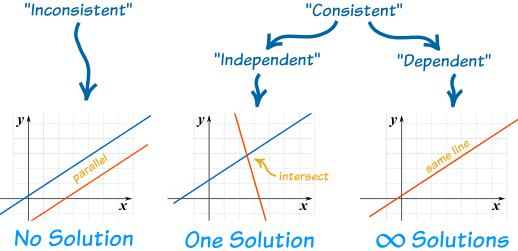
In fact there are only three possible cases:
- No solution
- One solution
- Infinitely many solutions
When there is no solution the equations are called "inconsistent".
One or infinitely many solutions are called "consistent"
Here is a diagram for 2 equations in 2 variables:
Independent
"Independent" means that each equation gives new information.
Otherwise they are "Dependent".
Otherwise they are "Dependent".
Also called "Linear Independence" and "Linear Dependence"
Example:
- x + y = 3
- 2x + 2y = 6
Those equations are "Dependent", because they are really the same equation, just multiplied by 2.
So the second equation gave no new information.

No comments:
Post a Comment